
Right now, with oil supply concerns and rising raw material costs, chemical fertilizer prices have been climbing steadily. More and more farmers are genuinely struggling with what fertilizer costs to keep going.
The natural farming Mokichi Okada described 75 years ago — I find myself thinking, more and more, that the time has finally come when we actually have to do this.
Of the benefits Okada listed, several I’ve experienced myself: fertilizer costs drop to zero, pest damage falls so much that pesticide use shrinks naturally, the crops hold up better against extreme weather, and the taste — the taste is something else entirely.
To be honest, though, the “labor cut in half” and “yields dramatically higher” parts — I haven’t fully reached those yet. There are still days when the weeding feels endless. I suspect many farmers feel the same way.
But I keep going, because I believe that if you stay with natural farming long enough, you do get there. The longer I practice it, the more I feel that Okada was seeing something the rest of us are only now beginning to catch up to.
What if the solution to food shortages, soil depletion, and rising farming costs had already been worked out — 75 years ago, by a Japanese thinker most of the world has never heard of?
Mokichi Okada wrote his essay on natural farming in 1951, in a Japan still recovering from war and facing serious food shortages. His message was simple: modern farming had been doing it wrong, and the fix didn’t require new technology. It required letting the soil do what soil already knows how to do.
Numbers That Sound Too Good to Be True
Okada laid out what farmers could expect when they switched to natural farming. His projections, based on more than a decade of real-world testing, were these:
- Year 1: Normal harvest, or 10–20% more
- Year 2: 20–30% more
- Year 3: 30–50% more
- Year 4: Over 50% more
He was deliberately conservative. The actual results in many fields exceeded these numbers. But even at these estimates, the implications were enormous: farmers could grow significantly more food, year after year, without buying any fertilizer.
The Benefits Beyond Yield
Increased harvest was only the start. Okada listed other practical benefits that came with natural farming:
- Fertilizer costs drop to zero
- Pest damage falls dramatically
- Flood and storm damage is greatly reduced
- The crops themselves taste better
- The grain is firmer and yields more usable food per pound
- The labor required is cut roughly in half
For a farmer, any one of these would be worth pursuing. Together, they describe a way of farming that is easier, cheaper, more productive, and more resilient than the conventional approach.
Not a Religious Project
Okada was clear about one point. Natural farming was not a tool for spreading his spiritual teachings. Anyone who applied the method — believer or not — would see the same results.
This matters because it places natural farming squarely in the realm of practical agriculture, open to anyone willing to try it.
The Bigger Picture
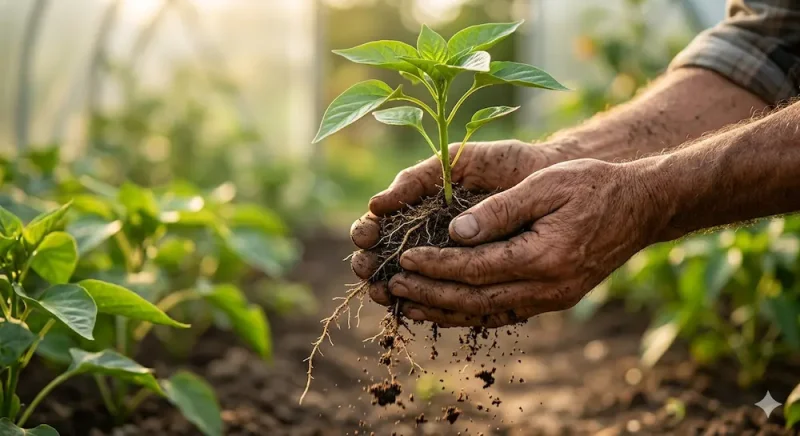
For Okada, this wasn’t only about better harvests. He saw modern farming as having taken a fundamentally wrong turn — one that was making the soil weaker, the food less nourishing, and the farmer’s life harder than it needed to be. Natural farming, he believed, was a return to something that had been there all along.
He called it “a great light cast into the dark world of agriculture.”
Seventy-five years later, with soil degradation, climate volatility, and food security back at the center of global conversation, his words feel less like history and more like a quiet challenge.
Who Was Mokichi Okada?
Mokichi Okada (1882–1955) was a Japanese thinker who believed that human health, the health of the soil, and the harmony of nature were inseparable. His writings on natural farming were grounded in over a decade of practical experimentation.
Read the Original
The full text — written by Okada in Japanese in 1951 — is available on meshiya.jp.
👉 結論(自然農法解説)

Natural Farming Series — All Articles
- Modern Farming Is Losing Its Balance
- The Soil’s Secret Strength
- Why Pesticides Are Making the Problem Worse
- When Floods and Typhoons Hit, Some Farms Survive. What’s Their Secret?
- Why Do Parasites Thrive — And What Does Our Food Have to Do With It?
- Can an Ancient Japanese Practice Help Crops Grow Better?
- Why Your Home Garden Isn’t Thriving
- The Quiet Revolution ← You are here