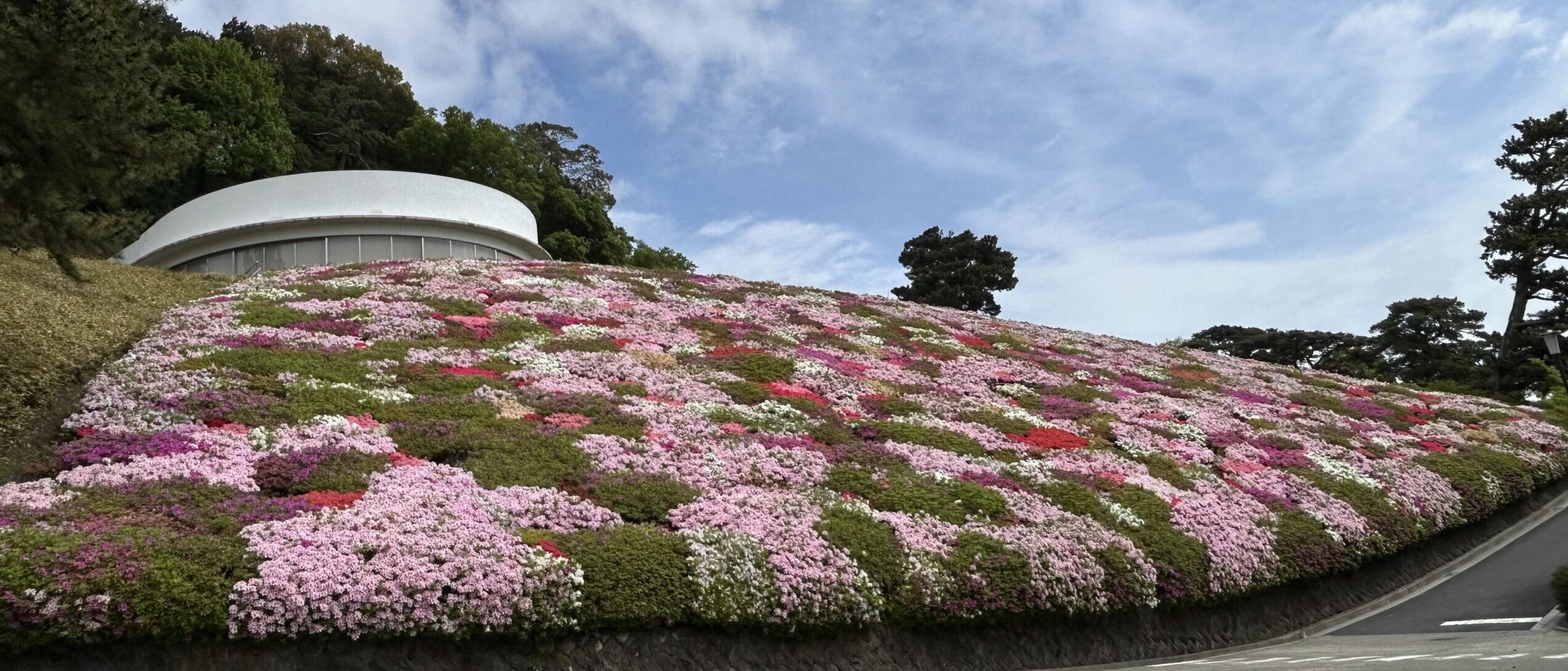


My mother has planted lots of flowers around our house. In winter, when few are in bloom, the place looks bare and a little lonely.
Now and then, there are no flowers inside the house either. I feel it right away, and I’m reminded how much a few flowers brighten my heart. So I make sure we always have some at home.
I used to volunteer at a care facility, arranging flowers there. People were so happy to see them.
A world like heaven must be a world full of healing. I believe flowers are a work of art given to us from above.
Think about the last time you walked into a room with fresh flowers on the table. You probably didn’t stop to think about it. But the room felt different: softer, brighter.
In May 1949, just four years after the end of the Second World War, a Japanese thinker named Mokichi Okada wrote a short essay about that feeling. His idea was simple. Flowers should not belong only to people who can afford them. They should be wherever people are.
What Would Heaven on Earth Look Like?
Okada often spoke of building a “heaven on earth.” He described it as a world where truth, goodness, and beauty are fully realized. His work on health and his farming without fertilizer were, in his view, part of that goal. But he believed something else mattered too: lifting people’s hearts through beauty.
Beauty for the Eyes
Okada noticed an imbalance. Beauty, he wrote, reaches us mainly through three senses: the ears, the eyes, and the tongue.
For the ears, times had never been better. Radio, record players, and recordings had brought music into everyday life.
For the eyes, it was a different story. There was theater, and there was film, and Okada admitted these were wonderful. But they cost time and money, and you had to travel to enjoy them. What people needed, he said, was something simple and close at hand, a way to touch beauty at any time.
His answer was flowers.
A Flower in Every Room, Even in Prison
Okada proposed growing flowers and sharing them widely, so they could brighten homes and every kind of room. Middle-class and wealthier homes already had them, he noted. That was not enough. His aim was for flowers to be seen by everyone, whatever their class and wherever they were.
He didn’t need to explain, he wrote, how much freshness a single flower brings to the corner of an office or a desk in a study. Then he went further. Ideally, he wanted to place a spray of flowers even in jails and prisons. Imagine, he suggested, the good effect it might have on the minds of the people held there.
If society became a place where there are always flowers wherever people are, Okada believed, it would do much to ease the hellish side of the world around him.
Making Flowers Affordable
There was a practical problem: flowers were expensive. For his idea to work, they had to become very cheap. So Okada called for growing far more flowers, as long as it did not take away from growing food.
He also pointed out that Japan was said to have more kinds of flowers than any other country, and some of the best growing methods in the world. Before the war, tulips grown in the Echigo region (today’s Niigata) had been exported in large numbers, and white lilies from Kanagawa had been shipped to Britain and America. Americans, he had heard, longed for rare Japanese flowers they could not find at home. Flowers, he suggested, could even help Japan earn money from abroad.
To put the idea into action, Okada’s group was clearing about eight acres of land near the Atami Plum Garden. The plan was to gather every kind of flower in Japan into one model garden, and dozens of volunteers were already at work.
A Question for Today
Today, flowers are far easier to buy than they were in 1949. Still, Okada’s idea is worth thinking about. Where in your day is there no beauty at all? A single flower might be enough to change it.
Who Was Mokichi Okada?
Mokichi Okada (1882–1955) is known today for a farming method that uses no fertilizer at all, and for a large body of writing on health, art, and how people ought to live. In 1952, he opened the Hakone Museum of Art.
Read the Original
The full text, written by Okada in Japanese in 1949, is available on meshiya.jp.
